


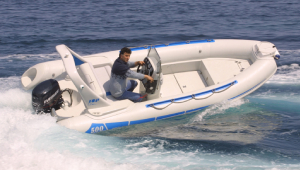

The idea
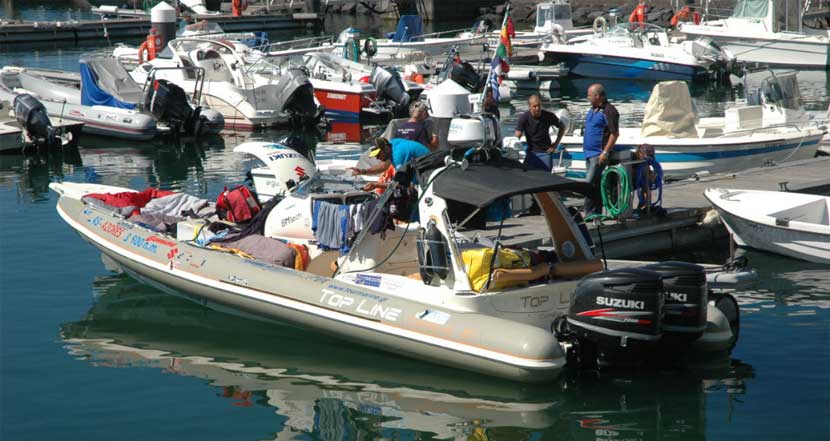
And the journey has always been our great passion. The allure of the endless blue, the scent of the sea, and the absolute sense of freedom have been an inseparable part of our lives for many years. As lovers of long trips and many hours of sailing on the open sea, this time we decided to venture out into the vast ocean.
The idea was born about a year ago, yet it seemed like an unattainable goal with many obstacles that appeared insurmountable. But as our will and passion grew stronger, the obstacles began to scatter one by one, becoming like paper towers ready to collapse.
Until the idea matured enough… and here we are again, on nautical charts, plotting courses, calculating miles, and working hard to achieve yet another small feat, which is scheduled for the end of next July.
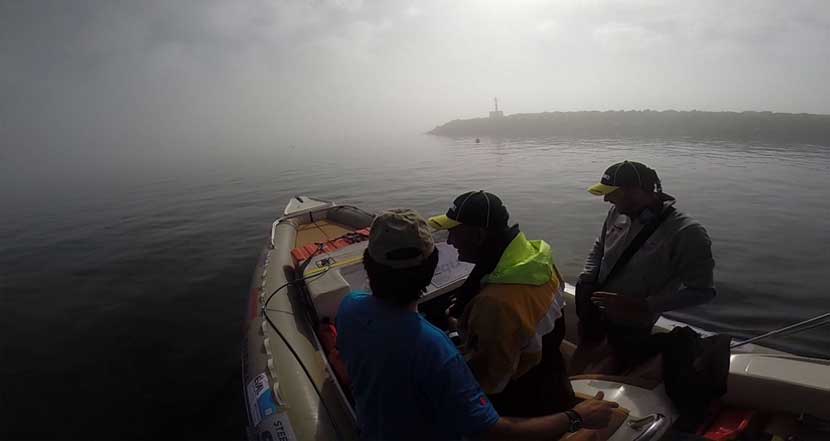
Crossing the Mediterranean is always a great challenge. However, an even greater challenge is the Atlantic Ocean, which very few have dared to cross so far.
Carrying the message "Mediterranean unites us," our goal is to cross the Mediterranean again, but this time to continue for 800 nautical miles into the open ocean, reaching the Azores, covering a total distance of more than 3,500 nautical miles.
We believe that especially the crossing of the Atlantic Ocean from Portugal to the Azores, which we expect to take two days and two nights, without the possibility of refueling, will be one of the top maritime events of 2014 for all of Europe.
The rib of our mission

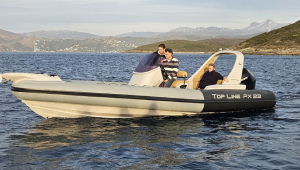
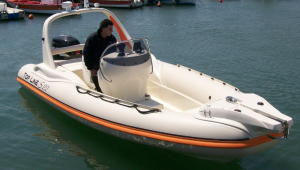
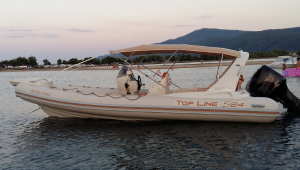
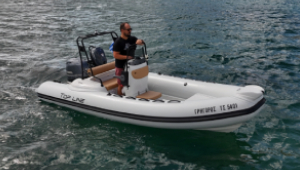
We would like to inform you that the inflatable boat with which we will undertake this journey has already been provided to us.
It is the Corsair 31, manufactured by the company TOPLINE. It is an inflatable boat of Greek design and production, with many significant accolades in speed races both in Greece and abroad.
Without a doubt, it is one of the best boats in its category, worldwide.
The reasons we chose it are clear:
- It is an inflatable with a sturdy construction and exceptional quality, which protects us from potential issues during the journey.
- It is famous for its fast and very economical hull.
- Its sailing, even in rough weather, is incredibly smooth, meaning it will make our otherwise strenuous journey more comfortable.

Its most economical cruising speed is around 32 knots, which ensures the fastest approach to our destinations, leaving more time for the much-needed rest.
The combination of its economical hull with the extremely low fuel consumption of the SUZUKI engines will provide us with the lowest possible fuel usage, which is particularly important for the long stretch of 800 nautical miles from Lisbon to the Azores.
Another important reason is that we expect to reach a cruising speed of 32 knots with the engines running at just 3500 rpm.
This means the engines will be working "effortlessly" throughout the entire journey.
Our engines
For this mission, we selected two new DF300AP engines from Suzuki, which have undergone very significant and technologically remarkable modifications.
Let’s take a look at some of these:
First, it is important to emphasize that the new DF300AP engine can operate as either a right-handed or a left-handed motor, depending on our preference, with just a simple electronic adjustment.
This is the first time such a feature has been applied to outboard motor technology, and we believe that Suzuki’s global innovation will redefine the design of future four-stroke engines.
With the Lean Burn technology, fuel consumption is further improved at low and medium RPMs, resulting in the new engines being 14% more fuel-efficient than previous models, without affecting their explosive torque.
By using an oxygen sensor in the exhaust, the best possible air-fuel ratio is achieved, resulting in better combustion and greater fuel savings.
At the foot of the new engines, we will notice several significant changes:
- While maintaining the same gear ratio, the gear that drives the propeller shaft has been redesigned to ensure greater durability at high temperatures and better resistance to mechanical stress.
- The water intakes for engine cooling have increased from two to four. The two new intakes are positioned at the front of the gear case, significantly improving water flow, especially at high speeds, enhancing engine cooling and allowing for even higher settings and trim angles.
- The gearbox has been completely redesigned to create the necessary space for the new gears of the selective rotation system. Although the gearbox has increased in size, its design, along with its highly optimized hydrodynamic shape, allows it to move with less resistance in the water, which increases the engine's performance.